AI TOOL / #08175
Suppa
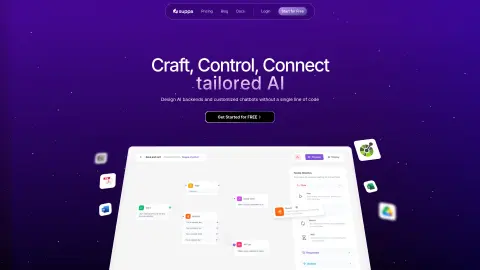
A code-free platform designed for developing AI backends and customized chatbots.
Introduction
No-code platform for designing AI backends and customized chatbots.
What is Suppa?
Suppa is a code-free platform that allows users to design AI backends and customized chatbots without having to write any code. It enables the creation of intelligent chatbots that can answer questions and perform system operations, and these bots can be deployed on both web and mobile platforms. Suppa helps businesses automate customer support, sales, and internal processes, enabling them to quickly respond to customer inquiries and handle support tasks even outside of regular office hours. As a result, this leads to increased customer satisfaction and higher customer retention rates.
How to use Suppa?
Use the code-free canvas to create dialogue flows, connect data from multiple sources, integrate systems through API operations, and quickly add AI capabilities to your platform. You can start a free trial and choose the plan that best meets your business needs.
The core functions of Suppa
Code-free AI chatbot builder
Integration of data from multiple sources
Powerful API functionality
Integration of Mobile SDK
Knowledge base retrieval
AI-generated responses
Transfer the conversation to AI.
Integration of data from multiple sources
Powerful API functionality
Integration of Mobile SDK
Knowledge base retrieval
AI-generated responses
Transfer the conversation to AI.
Related
Faraday.dev
Backyard AI: Chat with AI characters offline, create custom stories, and access powerful AI models.
bestchat.com
A customer service and sales engagement platform with live chat and AI chatbot capabilities.
OpenAssistantGPT
An open-source platform used for building AI chat assistants using OpenAI’s CustomGPT technology.
Gali AI
A platform for creating custom AI chatbots based on your data, designed for websites.
New LongCat
Meituan Totoro Native Multimodal Large Model
GPT-trainer
An AI chatbot building tool that uses custom data to generate contextual responses, and can be integrated into websites and Slack platforms.